· 7 min read
When a Learner Gets Stuck, Find the Missing Step
A practical way to uncover a missing idea, give focused support, and help learners see the progress they are making.
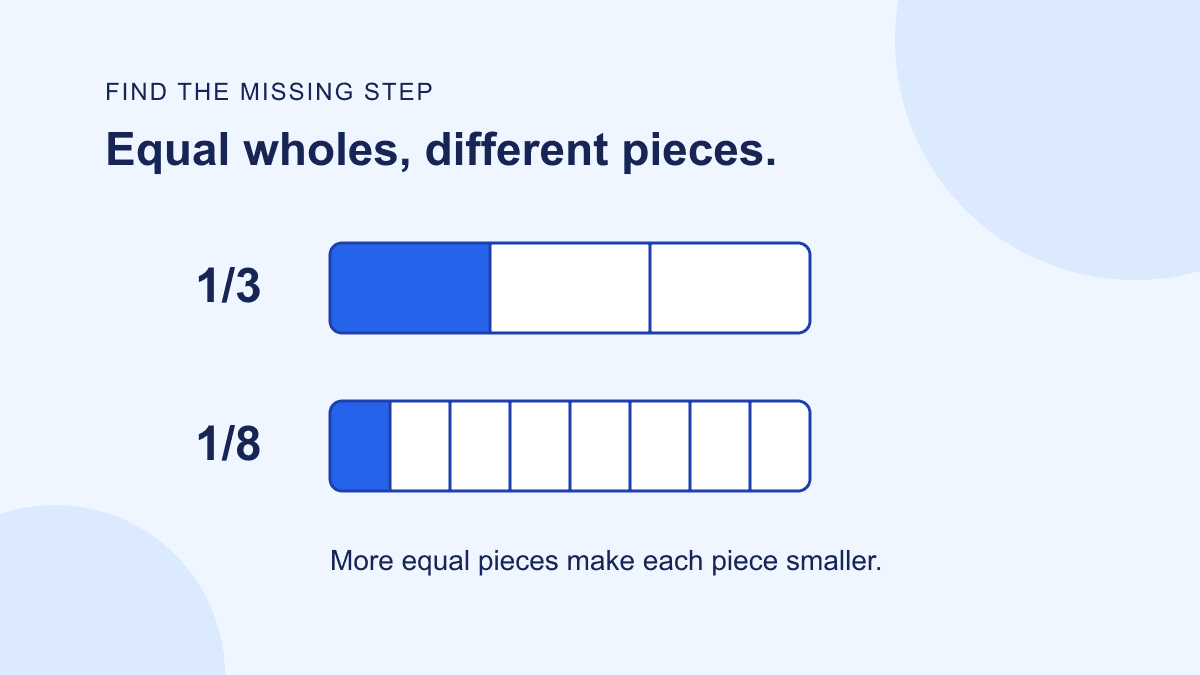
Consider a learner comparing one third with one eighth. They choose one eighth and explain, “Eight is bigger than three.”
There is reasoning in that answer. They know how to compare whole numbers and have carried that knowledge into a new situation. You now have a useful place to begin: what do those numbers mean when they describe parts of a whole?
A page of extra fraction questions might give them more opportunities to repeat the same reasoning. A carefully chosen question, followed by an explanation they can use, could help you find the idea that needs attention.
That distinction matters. “I don't get fractions” sounds like a large problem. “I am comparing the number of pieces without considering their size” gives an educator something specific to teach and a learner something achievable to work on.
Listen for the point where the reasoning changes
A wrong answer is a clue. Its usefulness depends on what you learn next.
Ask the learner to draw two same-sized rectangles. Have them divide one into three equal parts and the other into eight equal parts, then shade one part of each. Ask which shaded part is larger and how the drawing connects to their original answer.
You may discover that they can see the difference immediately. Or they may divide the rectangles into unequal parts, revealing an earlier idea to revisit. Someone else may understand the picture but have difficulty connecting it to the fraction notation.
Those responses call for different support. Before choosing it, try a second example or ask for another explanation. One answer should begin an investigation, rather than settle your judgment about someone's understanding.
The What Works Clearinghouse's 2021 guidance on elementary mathematics intervention recommends systematic instruction, clear mathematical language, and carefully chosen concrete and visual representations. For this example, a drawing gives you a way to connect the words, symbols, and quantities the learner is trying to make sense of.
The same habit applies beyond mathematics. In reading, someone may recall events accurately yet struggle to explain why a character acts. In science, someone may recognize a term without being able to use it to explain an observation. Ask for enough reasoning to locate the difficulty before deciding what to revisit.
Teach the idea that makes the next task possible
Once you have a plausible starting point, choose a small, clear goal. In the fraction example, that might be: explain why one eighth of a whole is smaller than one third of that same whole.
Keep the whole the same size while changing the number of equal parts. Model the comparison with a drawing or folded paper. Put the reasoning into words: splitting a fixed amount into more equal pieces makes each piece smaller.
Then give the learner a turn. Compare one fourth with one sixth, and ask them to show their reasoning. Let them refer to the representation while they are still connecting the ideas. As their explanation becomes more secure, try a new example without the completed model beside it.
Be careful about the rule they take away. A larger denominator does not make every fraction smaller: three eighths is larger than one third. After exploring fractions with a numerator of one, return to the original lesson's full range of comparisons. That reveals whether the support has helped them think about the quantities, or whether they have learned another shortcut to apply too broadly.
A focused task is useful because you can see what it is doing. You have a reason for assigning it, an idea to listen for, and a next problem that will help you judge whether it worked.
Give feedback they can act on now
“Check your answer” leaves the learner to find the problem and solve it. Sometimes that is appropriate. When the missing idea is still unclear, a more specific prompt helps.
For example: “Your two wholes need to be the same size before you compare the shaded parts. Redraw them with matching lengths, then compare.”
The prompt identifies one change to make. Give them time to make it and explain the new answer. That response tells you more than their agreement that the feedback makes sense.
The Education Endowment Foundation's guidance on effective feedback emphasizes strong initial instruction, feedback that moves learning forward, and planning for learners to receive and use it. In practice, the work after the feedback deserves attention too.
You can make improvement visible by returning to the earlier attempt. Ask what changed in the drawing or explanation. A learner who can identify that change has something concrete to remember the next time a similar problem appears.
Check what holds up independently
A correct answer immediately after a demonstration is encouraging. You will learn more by changing the example and coming back to the idea later.
Use a new pair of fractions, a different representation, or a short explanation without the worked solution on display. Include a brief check in a later lesson. If the same difficulty returns, look at where the reasoning breaks down again and adjust the support.
The Institute of Education Sciences' guide to organizing instruction and study recommends spacing learning over time, alternating worked examples with independent problems, using quizzes to revisit important content, and asking questions that draw out explanations. These are useful ways to look beyond a successful first attempt.
You do not need a long assessment every time. A short task can give you another piece of evidence, especially when you can compare its reasoning with the earlier work.
Keep the destination in view
Focused support should have a clear connection to the work the learner is trying to do. Tell them what they are revisiting and why it will help: “We're working on the size of fraction pieces so you can compare these amounts with confidence.”
After that support, return to the task that prompted it. This gives the learner a chance to use the idea where it was needed, and gives you a chance to see whether the explanation transfers.
That connection also helps you organize supplemental practice. A learner should be able to see what they have completed, what they are working on, and how the next task relates to their goal. An unfinished step is easier to interpret when its purpose is clear.
PushPad's lesson pads focus on one concept through vocabulary, explanation, an example, an activity, practice, problems, and a quiz. Educators can place focused support within an assigned learning path and adjust its sequence for an individual learner. You choose and confirm those changes, then review the resulting work alongside the learner's wider classroom learning.
A pad can organize opportunities to explain, practice, and try again. Your observations determine whether the support is addressing the difficulty you intended. That judgment remains part of teaching.
For the next learner who gets stuck, start with one genuine attempt. Find something their reasoning already explains, and locate the first point that needs help. Choose support that addresses it, then return to the original challenge.
Success becomes visible when they can explain what changed and use that understanding on their next attempt.
Research behind this article
- What Works Clearinghouse: Elementary mathematics intervention, 2021. Guidance for mathematics intervention in the elementary grades, including explicit instruction, mathematical language, and representations.
- Education Endowment Foundation: Effective feedback, 2021. Guidance on the foundations, timing, and use of feedback across subjects.
- Institute of Education Sciences: Organizing instruction and study, 2007. Recommendations concerning worked examples, spaced review, quizzing, and explanatory questions.
These sources inform the teaching practices discussed here. The fraction example illustrates the teaching process.