· 6 min read
Gradual Release: I Do, We Do, You Do
How to move learners from your worked example to independent work without pulling support too early or holding on too long.
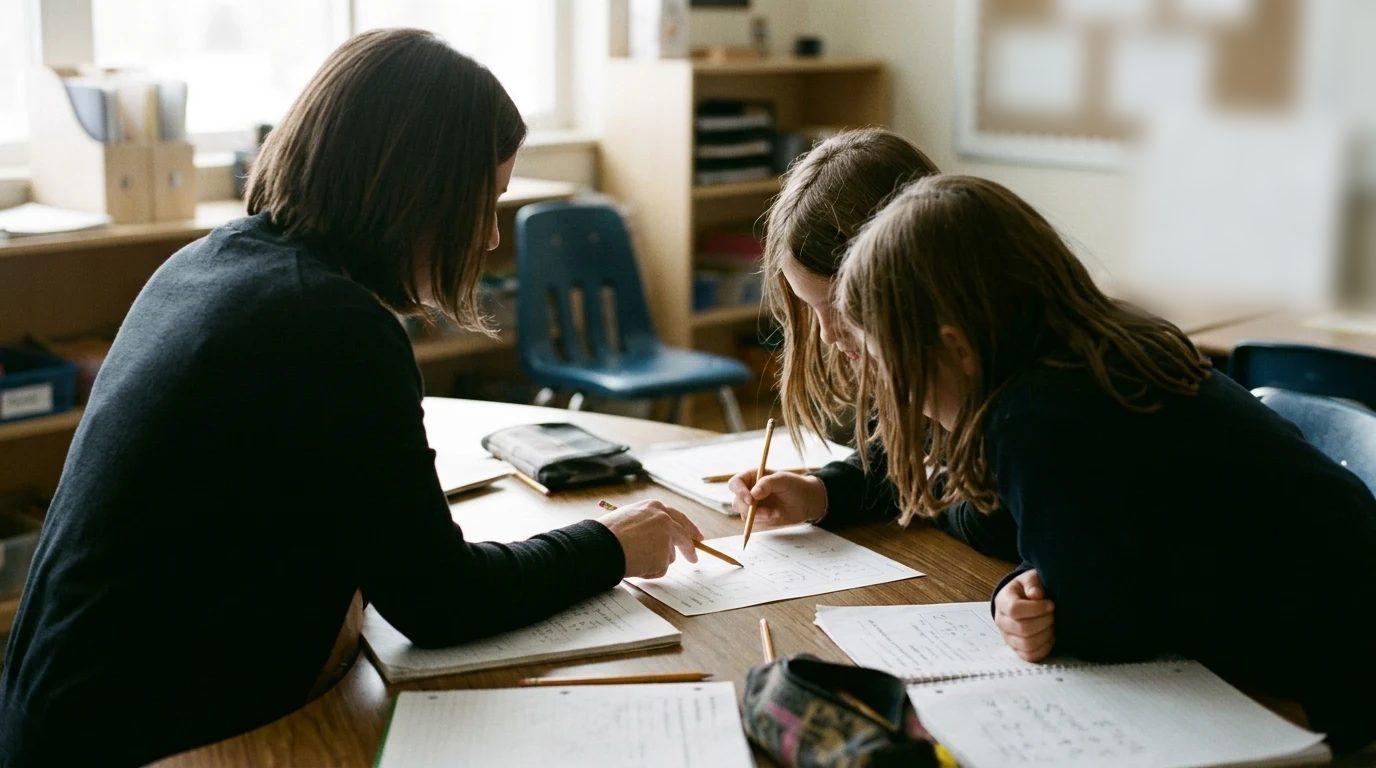
You model a two-step equation on the board and see plenty of nods. Then you hand out ten problems, and within five minutes three hands are up and two learners have quietly stopped working. Your example was clear enough. The jump from watching to doing was too big.
Gradual release is the practice of building that bridge on purpose. P. David Pearson and Margaret Gallagher described the model in 1983 for reading comprehension: responsibility for a task shifts from the educator to the learner in stages, with guided practice in between. Most educators know it as "I do, we do, you do." The labels are easy to remember, but the middle stage is the one that tends to get squeezed.
I do: show one problem and say what you're thinking
A worked example helps when learners can see the decisions behind the steps. "Subtract 5 from both sides" is a step. "I want x by itself, the 5 is in the way, and subtracting undoes adding" is the decision that produced it, and that's the part to say out loud.
Keep the first example typical. Hold back the awkward cases, like a negative coefficient or a variable on both sides, until learners have the basic move.
Worked examples have a long research record. In algebra experiments by John Sweller and Graham Cooper, learners who studied worked examples went on to solve similar problems faster and with fewer errors than learners who worked the same problems out for themselves. The advantage was clearest on problems that resembled the examples, which is one reason the later stages need more varied practice.
We do: make guided practice longer than feels necessary
Guided practice is usually what gets cut when the clock is running and a few learners look ready. Barak Rosenshine's summary of research on instruction found that more effective educators spent more time on guided practice, asked more questions, and checked more learners' work before moving on. He also suggested aiming for a success rate of about 80 percent during practice.
In a good "we do" problem, the learner does part of the work while your help is still close by. A few ways to set that up:
- You start a problem and learners finish it.
- Everyone writes the first step on a mini whiteboard and holds it up before anyone continues.
- Partners solve a problem together, then each explains one step to the other.
- Learners get a completed example with one step blank and fill it in.
That last format, sometimes called a completion problem, sits halfway between studying an example and solving alone.
Look at the pattern of answers before moving on. If most are right and the wrong ones are all different, learners are ready for more independence. If the same mistake shows up across the room, the class needs another example rather than more practice.
You do: start with familiar problems
Independent practice should open with problems that look like the ones you modeled. Learners are using the idea alone for the first time, and early success keeps them going. Bring in the harder variations once the basic move is reliable.
Let learners look back at the worked example at first, then take it away. If a learner can only solve problems with the example in view, they're still in the "we do" stage. The same test applies to homework: assign it once learners can start without help.
Fade the support as learners improve
Worked examples help most while a skill is new. Once learners know it, studying examples can slow them down, an effect researchers call expertise reversal. The scaffold that helped on Monday may be in the way by Friday, so pull it back as learners show they don't need it.
The Institute of Education Sciences' guide to organizing instruction and study recommends alternating worked examples with problems learners solve on their own, and shifting toward independent problems as expertise grows.
How a PushPad lesson pad follows this sequence
A PushPad lesson pad covers one concept in the same order. After a short vocabulary section, the explanation and example come first, then an activity where learners explore the idea. Practice keeps its authored order, moving from guided recognition toward independent use, and it isn't scored. Problems and a quiz come last, and those scores count toward mastery.
Every section has Read aloud, so reading level doesn't decide whether a learner can follow the example. You can review and edit each pad before assigning it, which is a good time to add the thinking you'd say aloud while modeling in class.
Common questions
What's the difference between modeling and a worked example?
Modeling is the live demonstration, usually with the educator thinking aloud. A worked example is a fully solved problem that learners can study and refer back to. Both show the steps, but a written worked example stays available after the demonstration is over.
What does "you do together" mean?
Some versions of gradual release, such as Douglas Fisher and Nancy Frey's, add a collaborative stage between guided and independent practice. Learners work through problems with a partner or small group before working alone, which gives them a chance to explain their thinking to each other while the educator circulates and listens.
Research behind this article
- Pearson and Gallagher: The instruction of reading comprehension, 1983. The original description of gradual release of responsibility.
- Sweller and Cooper: Worked examples as a substitute for problem solving in learning algebra, 1985. Experiments comparing worked examples with conventional problem solving.
- Rosenshine: Principles of instruction, 2012. A summary of research on modeling, guided practice, and checking for understanding.
- Kalyuga, Ayres, Chandler, and Sweller: The expertise reversal effect, 2003. Why support that helps beginners can hinder more experienced learners.
- Institute of Education Sciences: Organizing instruction and study, 2007. Recommendations including alternating worked examples with independent problems.
The classroom example illustrates the teaching process. It is not drawn from a specific learner.
Put this into practice with lesson pads you control.